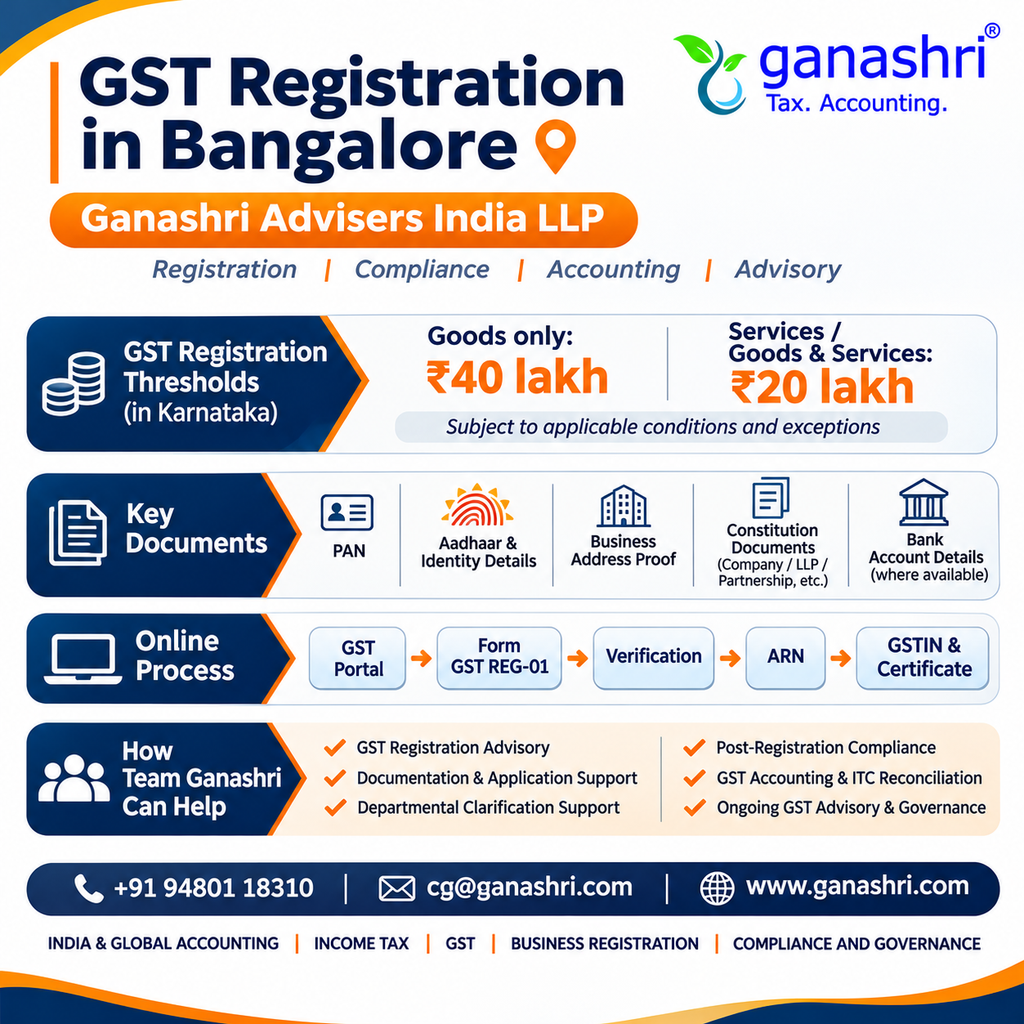
GST Registration in Bangalore | Ganashri Advisers India LLP
Starting a business, expanding operations or providing professional services in Bangalore? Understanding Goods and Services Tax (GST) registration is an important step towards establishing a compliant and scalable business.
Whether you are a startup founder, freelancer, consultant, manufacturer, trader, e-commerce seller or an established company, obtaining GST registration at the appropriate time helps you meet statutory obligations, issue compliant tax invoices and manage eligible Input Tax Credit (ITC).
At Ganashri Advisers India LLP, we support businesses with GST registration, accounting, taxation and ongoing compliance, helping entrepreneurs focus on business growth while maintaining sound financial governance.
This guide explains GST registration in Bangalore, including eligibility, turnover thresholds, compulsory registration, documentation, the online application process, registration costs, common mistakes and post-registration responsibilities.
1. What is GST Registration?
GST registration is the process through which a business or individual obtains registration under India’s Goods and Services Tax framework.
Upon successful registration, the taxpayer receives a unique 15-digit Goods and Services Tax Identification Number (GSTIN), linked to the taxpayer’s PAN and State of registration.
GST registration enables eligible businesses to:
- Collect GST on taxable supplies.
- Issue GST-compliant tax invoices.
- Claim eligible Input Tax Credit, subject to statutory conditions.
- File applicable GST returns.
- Establish commercial credibility with customers, vendors and business partners.
- Participate in eligible B2B and government procurement transactions.
Important: GST registration is State-specific. A business operating from Bangalore generally requires Karnataka GST registration for its Karnataka place of business, subject to applicable provisions governing multiple locations and registrations.
2. Who Needs GST Registration in Bangalore?
Businesses operating in Bangalore, Karnataka must evaluate their aggregate turnover, nature of supplies, geographical reach and applicable compulsory registration provisions.
GST registration may be required for:
- Private Limited Companies and One Person Companies.
- Limited Liability Partnerships (LLPs) and partnership firms.
- Proprietorship businesses.
- Consultants, freelancers and independent professionals.
- Manufacturers, wholesalers, distributors and retailers.
- E-commerce sellers and eligible marketplace participants.
- Businesses providing taxable services.
- Businesses undertaking inter-State taxable supplies, subject to applicable exemptions and exceptions.
GST Registration Turnover Limits in Karnataka
The general registration thresholds applicable in Karnataka are:
| Business category | General annual aggregate turnover threshold |
| Suppliers exclusively dealing in goods | ₹40 lakh |
| Suppliers providing services | ₹20 lakh |
| Suppliers providing both goods and services | ₹20 lakh |
These thresholds are subject to prescribed conditions, statutory exceptions and applicable notifications.
How is aggregate turnover calculated?
Aggregate turnover is calculated on an all-India PAN basis and generally includes:
- Taxable supplies.
- Exempt supplies.
- Export of goods or services.
- Inter-State supplies.
It excludes GST and cess charged under the GST laws and inward supplies on which tax is payable under reverse charge.
Example: If a Bangalore-based consulting business earns ₹22 lakh in aggregate turnover during a financial year, it would ordinarily cross the ₹20 lakh service-provider threshold and become liable to GST registration, subject to the applicable provisions.
3. Is GST Registration Mandatory Below the Turnover Limit?
Yes, certain categories of businesses may require GST registration irrespective of their turnover, depending on the applicable statutory provisions.
Relevant categories include:
- Persons making inter-State taxable supplies, subject to specified exceptions.
- Casual taxable persons making taxable supplies.
- Non-resident taxable persons making taxable supplies.
- Persons liable to pay GST under specified reverse charge provisions.
- Persons required to deduct GST TDS under Section 51.
- Input Service Distributors (ISDs).
- Certain agents making taxable supplies on behalf of taxable persons.
- E-commerce operators and specified suppliers operating through e-commerce platforms, subject to applicable provisions and exemptions.
Important: Section 24 of the CGST Act, 2017 and subsequent notifications provide the framework for compulsory registration. Not every inter-State or e-commerce transaction automatically results in compulsory registration; applicable exemptions and special provisions must be examined.
4. Can a Business Obtain Voluntary GST Registration?
Yes. A business that is not otherwise required to register may voluntarily obtain GST registration, subject to applicable provisions.
Voluntary registration may be beneficial when:
- Your customers are predominantly GST-registered businesses.
- You want to claim eligible Input Tax Credit on business purchases.
- You intend to expand into B2B transactions.
- Your business plans to participate in eligible tenders.
- You anticipate crossing the registration threshold.
- Your commercial partners require a valid GSTIN.
However, voluntary registration also creates ongoing compliance responsibilities, including applicable return filing, invoicing and tax payment obligations.
Therefore, the decision should be based on commercial requirements, ITC eligibility, operating costs and compliance readiness.
5. Documents Required for GST Registration in Bangalore
The documents required depend on the constitution of the business, the applicant’s identity and the nature of the business premises.
A. Proprietorship
- PAN card of the proprietor.
- Aadhaar and prescribed identity details.
- Recent photograph.
- Business address proof.
- Electricity bill or other prescribed premises evidence.
- Rent agreement and owner’s consent documents, where applicable.
- Bank account details, wherever available and as required.
B. Partnership Firm
- PAN card of the firm.
- Partnership deed.
- PAN and prescribed identity details of partners.
- Photograph and details of relevant partners.
- Authorisation letter for the authorised signatory.
- Principal place of business proof.
- Bank account details, wherever available and as required.
C. Limited Liability Partnership (LLP)
- PAN card of the LLP.
- Certificate of Incorporation.
- LLP Agreement.
- LLPIN and designated partners’ DIN details.
- Prescribed identity and photograph details of relevant partners.
- Authorisation for the authorised signatory.
- Principal place of business proof.
- Bank account details, wherever available and as required.
D. Private Limited Company
- PAN card of the company.
- Certificate of Incorporation.
- Company identification details.
- Details and prescribed identity documents of relevant directors.
- Board resolution or authorisation for the authorised signatory, as applicable.
- Registered or principal place of business proof.
- Bank account details, wherever available and as required.
E. Proof of Business Premises
Depending on the nature of possession, the following documents may be required:
| Premises category | Typical supporting documents |
| Owned premises | Ownership document, property tax receipt or electricity bill, as applicable |
| Rented premises | Rent or lease agreement and prescribed ownership evidence |
| Consent-based premises | Consent letter and prescribed premises evidence |
| Co-working space | Relevant agreement, consent and premises evidence |
| Other arrangements | Documents prescribed for the selected premises category |
Note: The applicable document checklist must be verified against the current GST REG-01 requirements. Additional information or verification may be required depending on the applicant’s circumstances.
6. How to Apply for GST Registration Online in Bangalore?
GST registration applications are submitted electronically through the official GST portal.
Step 1: Visit the GST Portal
Visit https://www.gst.gov.in and navigate to:
Services → Registration → New Registration.
Step 2: Complete Part A of Form GST REG-01
Provide the prescribed details, including:
- Taxpayer category.
- State and district.
- Legal name as per PAN.
- PAN.
- Email address and mobile number.
Complete the required verification to generate a Temporary Reference Number (TRN).
Step 3: Complete Part B of Form GST REG-01
Enter the prescribed details relating to:
- Business constitution.
- Promoters, partners or directors.
- Principal and additional places of business.
- Nature of business activities.
- Goods and services supplied.
- HSN and SAC classifications.
- Bank account particulars.
- Authorised signatory.
Step 4: Upload Supporting Documents
Upload the documents applicable to the selected business constitution and premises category.
Step 5: Complete Aadhaar Authentication or Applicable Verification
Complete the authentication and verification process prescribed for the applicant. Depending on the case, biometric authentication, document verification or physical verification may apply.
Step 6: Submit the Application
Submit the application using the prescribed electronic verification method and obtain the Application Reference Number (ARN).
Step 7: Track the Application
Monitor the application status through the GST portal. If the department issues a clarification notice in Form GST REG-03, submit the required response in Form GST REG-04 within the prescribed period.
Step 8: Obtain GST Registration Certificate
Once approved, the GSTIN is allotted and the registration certificate in Form GST REG-06 is made available electronically.
7. How Long Does GST Registration Take?
The processing time depends on the completeness of the application, the applicable verification procedure and whether clarification or physical verification is required.
Under the applicable registration rules, processing timelines differ according to the verification route and circumstances.
An application may require additional time where:
- Documents are incomplete or inconsistent.
- Business address evidence is insufficient.
- Aadhaar authentication is unsuccessful or not opted for.
- Biometric or physical verification is required.
- The tax officer seeks additional clarification.
Our recommendation: Prepare the documentation correctly before filing instead of treating GST registration as a routine form-submission exercise.
8. What Is the Government Fee for GST Registration?
There is no prescribed government application fee for obtaining ordinary GST registration through the GST portal.
However, businesses may incur professional fees when engaging a GST consultant or tax advisor for:
- Eligibility assessment.
- Documentation and verification.
- Application preparation and submission.
- Departmental query responses.
- Registration-related advisory.
Professional charges vary according to business constitution, complexity, number of locations and documentation requirements.
9. Important GST Registration Changes Effective in November 2026
Businesses applying for GST registration should take note of the revised Form GST REG-01 introduced on the GST portal.
The revised application framework incorporates additional disclosures and standardised documentary requirements.
Important changes include:
- Separate classification for One Person Companies (OPCs).
- Revised details relating to principal and additional places of business.
- Specific classification for rented, leased, consent-based and co-working premises.
- Additional disclosures relating to business activities.
- Revised requirements for existing GST and Professional Tax registration particulars.
- Bank account details, wherever available, at the application stage; where unavailable, they are required within 30 days from the date of issuance of the registration certificate.
- DIN details of designated partners in LLP applications.
- Online validation of applicable corporate and LLP identification numbers.
These changes make it particularly important to review the application requirements before filing.
10. Common Mistakes to Avoid During GST Registration
Incorrect or incomplete information can result in departmental queries, processing delays or rejection.
Businesses should avoid the following mistakes:
- Incorrect legal name: Ensure that the legal name matches the PAN and applicable incorporation records.
- Incorrect business address: Verify the complete address and premises details.
- Inadequate address proof: Submit documents appropriate to the actual premises arrangement.
- Incorrect business constitution: Select the correct entity category.
- Incorrect HSN/SAC classification: Identify the nature of goods and services accurately.
- Incomplete promoter information: Ensure prescribed details of directors, partners and authorised persons are provided.
- Inconsistent documentation: Maintain consistency across PAN, incorporation documents, business address proof and application details.
- Ignoring departmental notices: Respond to clarification notices within the prescribed timelines.
11. What Should a Business Do After Obtaining GST Registration?
Obtaining GST registration is the beginning of GST compliance, not the end of it.
Businesses should establish appropriate accounting and compliance processes covering:
- Display of GST registration details as prescribed.
- Issuance of GST-compliant tax invoices and other applicable documents.
- Correct classification and application of GST rates.
- Maintenance of purchase and sales registers.
- Reconciliation of books of accounts with GST returns.
- Verification and claiming of eligible Input Tax Credit.
- Timely filing of applicable GSTR-1 and GSTR-3B returns.
- Payment of GST liabilities within prescribed timelines.
- E-invoicing and e-way bill compliance, wherever applicable.
- Maintenance of statutory records and supporting documents.
A robust accounting system and periodic GST reconciliation can help businesses identify discrepancies and reduce compliance risks.
12. Why Choose Ganashri Advisers India LLP for GST Registration in Bangalore?
Choosing a GST advisor should involve more than comparing registration charges. Businesses need an advisor who understands taxation, accounting, documentation, financial processes and ongoing statutory compliance.
How can we help you?
GST Registration Advisory
- Assessment of GST registration eligibility.
- Advisory on mandatory and voluntary registration.
- Selection of appropriate registration category.
- Guidance on Karnataka-specific requirements.
Documentation and Application Support
- Preparation and review of registration documents.
- Assistance with Form GST REG-01.
- Guidance on principal and additional places of business.
- Support with Aadhaar authentication and prescribed verification.
Departmental Clarification Support
- Review of GST REG-03 notices.
- Preparation of responses in GST REG-04.
- Assistance with documentation and application-related clarifications.
Post-Registration Compliance
- GST return filing support.
- Input Tax Credit reconciliation.
- GST accounting and ledger reconciliation.
- E-invoicing and e-way bill advisory.
- GST compliance review and risk management.
Integrated Accounting and CFO Support
- Cloud accounting using QuickBooks, Xero and Zoho.
- ERP accounting and financial process optimisation.
- Accounts Payable and Accounts Receivable management.
- Virtual CFO and MIS reporting services.
Our objective is to help businesses establish a reliable GST compliance framework that supports sustainable growth.
13. Frequently Asked Questions (FAQs) – GST Registration in Bangalore
Q1. What is the GST registration limit in Bangalore?
In Karnataka, the general threshold is ₹40 lakh for persons exclusively supplying goods and ₹20 lakh for persons supplying services or both goods and services, subject to applicable conditions and exceptions.
Q2. Is GST registration compulsory for a private limited company in Bangalore?
Not merely because the business is incorporated as a private limited company. GST liability depends on turnover, the nature and location of supplies and compulsory registration provisions.
Q3. Can I obtain GST registration for a home-based business in Bangalore?
Yes. Home-based businesses may obtain GST registration if they satisfy the applicable requirements and provide appropriate proof of their principal place of business.
Q4. Can I obtain GST registration without a commercial office?
Yes. A commercial office is not universally mandatory. Residential premises, rented premises, consent-based premises and eligible co-working arrangements may qualify, subject to applicable documentary and verification requirements.
Q5. Is GST registration free in India?
The government does not charge an ordinary GST registration application fee on the GST portal. Professional consultancy charges may apply.
Q6. Can a freelancer obtain GST registration in Bangalore?
Yes. Freelancers and independent professionals may obtain registration voluntarily or when they become liable under the applicable GST provisions.
Q7. Can I apply for GST registration without a current bank account?
Bank details are required wherever available at the application stage. Under the revised framework, where they are unavailable, the applicable bank details must be furnished within 30 days from the date of issuance of the GST registration certificate.
Q8. Can an LLP obtain GST registration in Bangalore?
Yes. An LLP can obtain GST registration by providing its incorporation details, LLP Agreement, LLPIN, prescribed designated partner information, business address proof and other applicable documents.
Q9. What happens if my GST registration application is rejected?
The applicant should review the rejection order and the reasons recorded by the proper officer. Depending on the circumstances, a fresh application or an appropriate legal remedy may be considered.
Q10. Can I operate my business after obtaining GST registration?
Yes. However, the business must comply with applicable GST requirements, including invoicing, tax collection, return filing, payment and record maintenance.
Q11. Is GST registration required for businesses selling through Amazon or Flipkart?
The requirement depends on the nature of supplies, the e-commerce model and applicable statutory provisions and exemptions. Certain eligible small suppliers may benefit from notified exemptions subject to prescribed conditions.
Q12. How can Ganashri Advisers India LLP help with GST registration?
Ganashri provides GST eligibility assessment, documentation assistance, online application support, departmental clarification assistance and post-registration GST compliance and accounting advisory.
Conclusion: Build Your Business on a Strong GST Compliance Foundation
GST registration is an important milestone in establishing a compliant business in Bangalore. However, the real value lies in ensuring that the registration is accurate, the business transactions are properly recorded and the subsequent compliance obligations are effectively managed.
Whether you are establishing a startup, operating a professional practice, expanding an existing business or entering the Indian market, the right GST advisory support can help you avoid unnecessary compliance challenges.
Connect with Ganashri Advisers India LLP for GST Registration and Accounting Advisory Services in Bangalore.
Ganashri Advisers India LLP
📞 +91 94801 18310
✉️ cg@ganashri.com
🌐 https://www.ganashri.com
Disclaimer: This article is intended for general information and educational purposes as of November 2026. GST registration eligibility, exemptions, documentation and procedural requirements depend on the facts of each case and applicable laws, notifications and circulars. Professional advice should be obtained before taking a registration or tax position.